
A logo can look perfect when an activewear sample is lying flat — and begin to crack as soon as the garment is stretched on the body.
For a brand, this can be particularly frustrating because the print or transfer may appear clean during sample inspection.
The edges are sharp.
The color looks correct.
The placement looks right.
But once the garment is worn, stretched repeatedly or washed, small cracks can begin to appear.
Why?
Because a logo applied to activewear does not stay on a static surface.
The decoration has to move with the fabric underneath it.
If the fabric stretches further than the decoration can tolerate, cracking can occur.
Why Do Logos Crack on Stretch Fabric?
Activewear fabrics can experience significant extension during normal wear.
Leggings stretch around the hips, seat, thighs and knees.
Sports bras and fitted tops stretch across the chest, underbust, shoulders and back.
When a logo is applied to these areas, it needs to tolerate the same movement.
If the decoration layer is less flexible than the fabric underneath it, tension begins to build inside the logo.
With enough extension or repeated movement, that tension can create:
- fine surface cracks
- separation between printed areas
- broken edges
- peeling
- distortion
- loss of visual quality
The important question is therefore not only:
“Does the logo look good?”
It is:
“Can this logo move with this fabric in this placement?”
Fabric Stretch and Logo Stretch Need to Work Together
The fabric and decoration should not be evaluated independently.
Imagine a highly elastic leggings fabric.
The material may stretch comfortably to accommodate movement, but a relatively rigid decoration applied to the surface may not extend at the same rate.
As the fabric expands, the logo is forced to follow.
If it cannot, the decoration may begin to crack.
This is why the stretch behavior of the base fabric should be considered when selecting a logo application.
For more about activewear fabric behavior, see how much stretch activewear really needs.
Not Every Logo Method Behaves the Same Way
Different decoration methods have different characteristics.
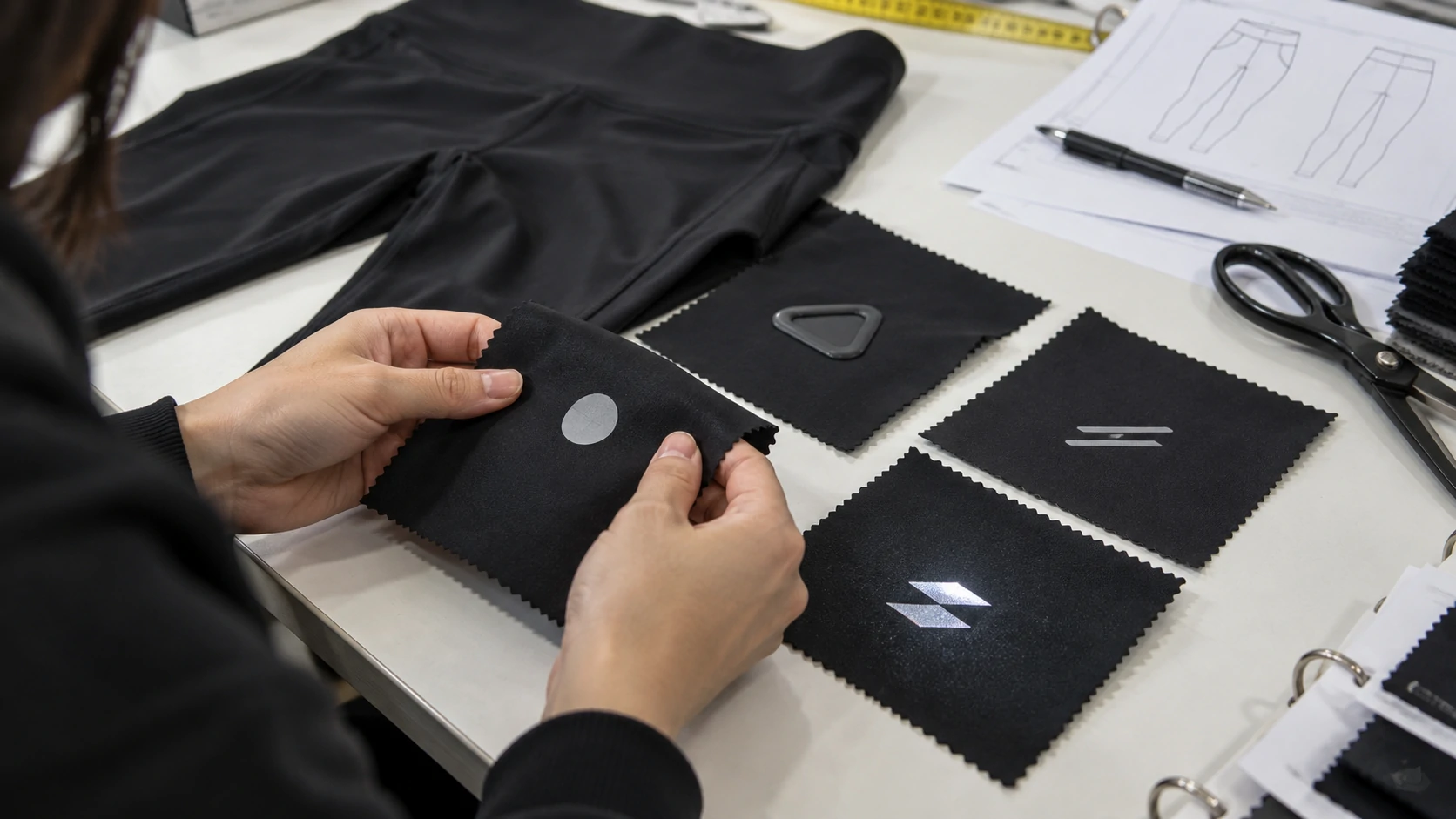
Depending on the design and material, activewear branding may use methods such as:
- screen printing
- heat transfer
- silicone transfer
- reflective transfer
- DTF
- embroidery
- other specialized applications
These methods do not all respond to stretch in the same way.
Some applications can accommodate significant movement.
Others are more suitable for areas where the garment experiences less extension.
Even within the same decoration category, performance can vary depending on the specific material, formulation and application process.
This is why choosing a logo method should involve more than selecting the appearance you prefer.
The intended fabric and placement also matter.
Logo Placement Changes the Amount of Stress
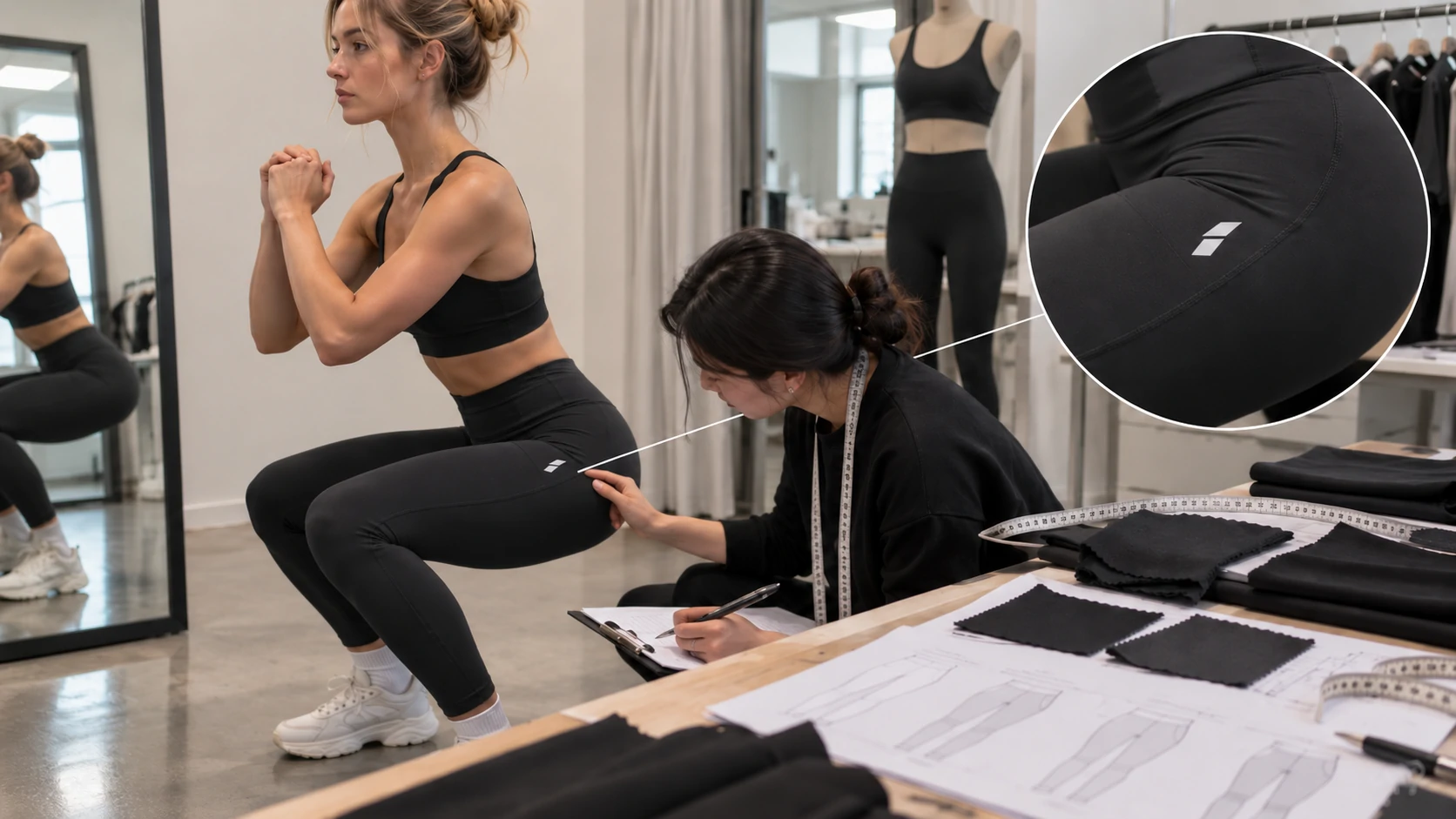
The same logo application can perform differently depending on where it is placed.
A logo positioned on a relatively stable area may experience limited deformation.
The same logo placed across a high-stretch area may be repeatedly pulled in multiple directions.
For example, high-stretch areas can include:
- seat
- hip
- thigh
- knee
- chest
- underbust
- shoulder
- upper back
The exact stress depends on the garment design and how the body moves.
A small change in logo position can therefore change how much tension the decoration experiences.
This should be considered during sample development rather than after bulk production.
Logo Size Can Affect Performance
Logo dimensions can also influence how the decoration behaves.
A very small logo may move with the fabric differently from a large solid graphic covering a wide area.
Large areas of decoration can create more resistance because a greater portion of the fabric surface is covered.
This becomes especially important when the artwork contains large solid sections.
A design with more open space may sometimes behave differently from a dense block of decoration.
The visual design and the physical behavior of the logo therefore need to be considered together.
Artwork Construction Matters Too
Two logos using the same application method may still perform differently.
Artwork characteristics can influence how stress is distributed through the decoration.
Consider differences such as:
- thin lines
- thick solid areas
- small isolated details
- large continuous graphics
- sharp corners
- open spacing
When the garment stretches, these elements do not necessarily experience tension in the same way.
This is why decoration testing should use the actual artwork, not only a generic test logo.
Application Conditions Can Affect Durability
Even when the correct decoration method has been selected, the application process still matters.
Depending on the technique, variables can include:
- temperature
- pressure
- application time
- curing
- adhesive performance
- surface preparation
If these conditions are incorrect or inconsistent, the logo may initially look acceptable but have weaker durability.
For example, an application may appear attached to the garment immediately after production but begin to fail after repeated stretching or washing.
This is why visual inspection immediately after application is not enough.
The finished decoration should also be tested.
Fabric Surface Can Affect Adhesion
Activewear fabrics can have different surface characteristics.
Some are smooth.
Some are brushed.
Some have special finishes.
Others may contain treatments designed to change moisture management, hand feel or appearance.
These characteristics can influence how certain decoration methods interact with the material.
A transfer that performs well on one fabric should not automatically be assumed to perform identically on another.
This becomes particularly important when a brand changes fabric during development.
As we discussed in why fit can change after switching fabric, changing material can affect more than one part of the finished garment.
Logo compatibility should be reviewed again as part of that change.
Do Not Approve a Logo While the Garment Is Flat
One of the easiest mistakes during sample approval is evaluating the logo only while the garment is lying on a table.
In this position, the decoration may be under almost no tension.
The edges look clean.
The surface looks smooth.
Everything appears correct.
But this does not reproduce the conditions the logo will experience during actual wear.
For fitted activewear, the logo should also be evaluated while the garment is:
- worn
- stretched
- bent
- moved
- released back to its relaxed state
The goal is to understand whether the decoration remains visually acceptable throughout the movement cycle.
Perform a Controlled Stretch Test
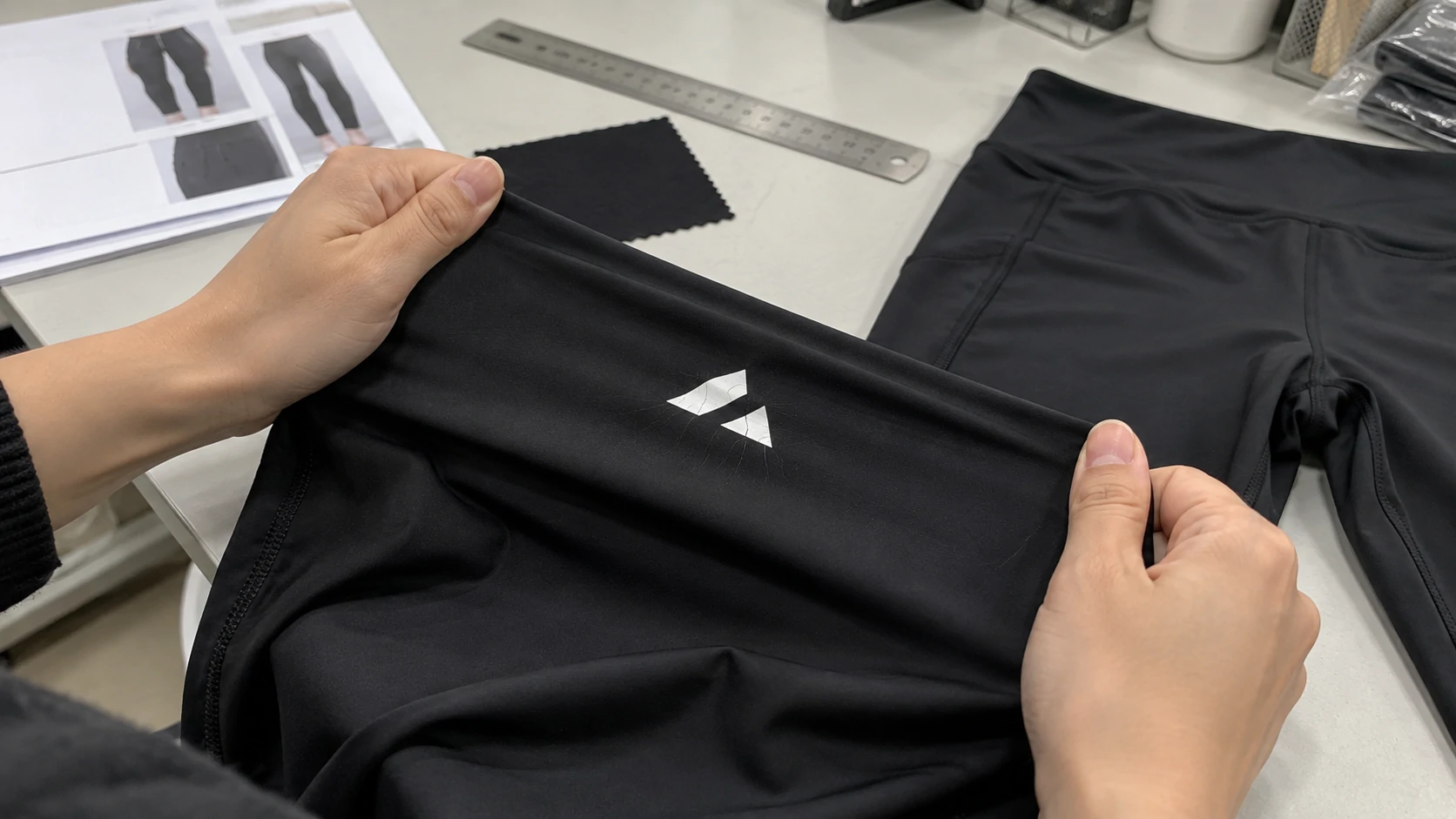
A useful development check is to observe the decorated area under realistic tension.
The garment or decorated fabric should be stretched to approximately the level it is expected to experience during wear.
Then inspect:
- surface cracking
- edge lifting
- distortion
- separation
- color change
- recovery after release
The purpose is not to stretch the logo as far as physically possible.
Extreme stretching may create conditions that the garment would never experience in normal use.
The test should represent the actual product.
Test the Logo on the Actual Production Fabric
Testing a logo on a random fabric swatch can provide preliminary information.
But final approval should use the material intended for production.
Why?
Because changing the fabric can change:
- stretch
- recovery
- surface texture
- finishing
- heat response
- adhesion behavior
A decoration system that works on one polyester/elastane fabric may not behave exactly the same way on another material with different construction or finishing.
The closer the test conditions are to actual production, the more useful the result becomes.
Check Recovery After Stretching
The logo should not only survive the stretched position.
It should also look acceptable after the fabric returns to its relaxed state.
After releasing the garment, check whether the decoration shows:
- permanent cracking
- wrinkles
- lifted edges
- deformation
- surface damage
Repeated stretch-and-release cycles can reveal problems that a single stretch does not.
Activewear is worn through repeated movement, so testing should reflect that reality.
Washing Can Reveal Problems That Stretch Testing Misses
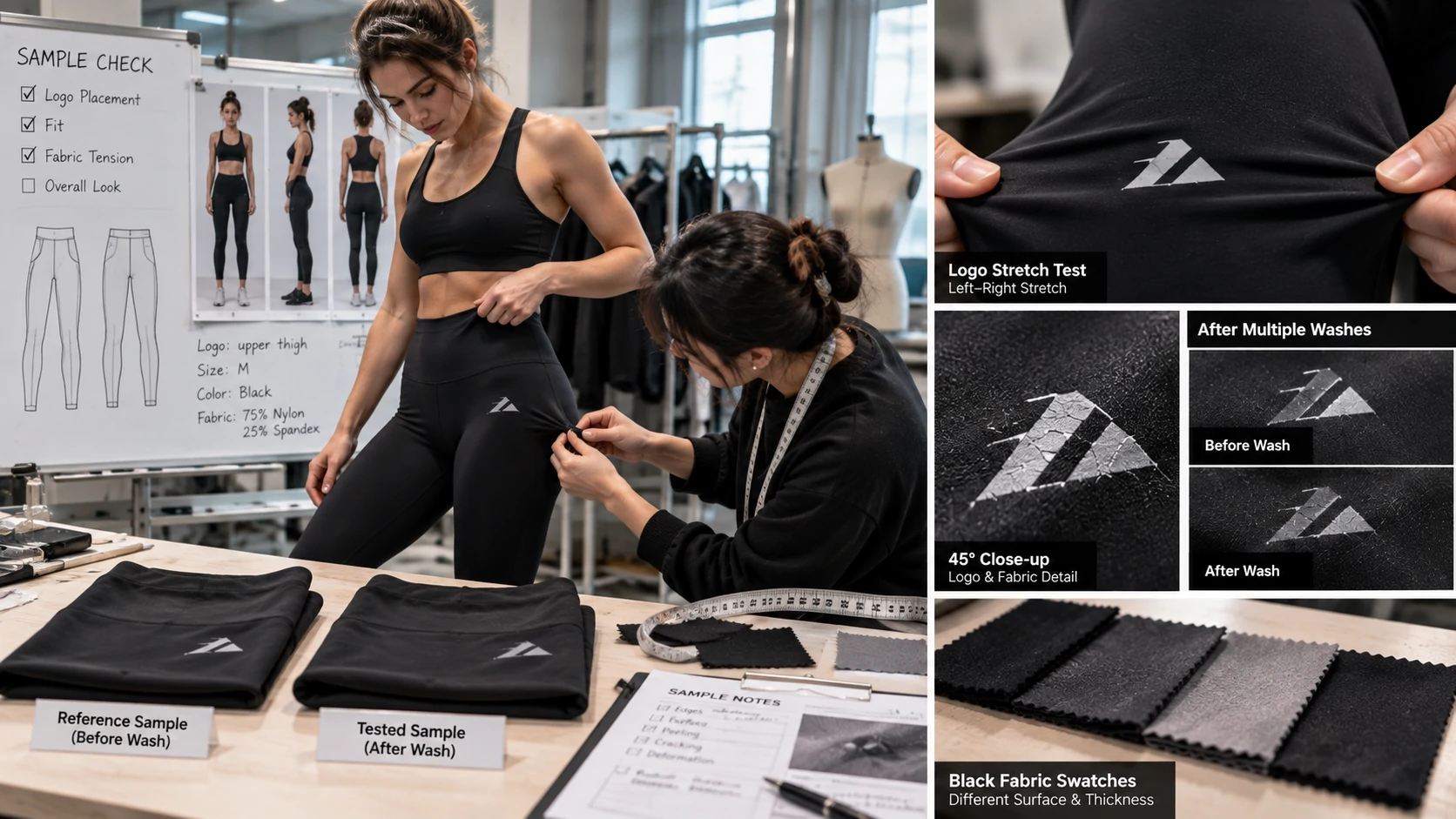
A logo may pass an initial stretch test and still develop problems after washing.
Heat, water, detergent and mechanical movement can affect the decoration and its bond with the fabric.
After washing, check whether the logo:
- remains attached
- maintains its surface
- retains clean edges
- still stretches without cracking
- returns correctly after stretching
For products intended for repeated training and washing, this can provide a more realistic picture of long-term performance.
The Logo Should Be Tested Before Bulk Production
Logo testing is most useful during development.
If cracking is discovered only after hundreds of garments have been produced, changing the decoration becomes much more difficult.
Before bulk production, confirm:
- production fabric
- actual artwork
- logo dimensions
- placement
- decoration method
- application settings
- stretch performance
- recovery
- wash performance
These variables should work as one system.
This is also why branding should be included in the final sample approval process rather than treated as a separate cosmetic detail.
For the broader checklist, see what you should check before approving a sample.
A Practical Activewear Logo Checklist
Before approving a logo application, review the main variables together.
| Check | What to Review |
|---|---|
| Base Fabric | Stretch, recovery and surface characteristics |
| Decoration Method | Suitability for the selected material |
| Artwork | Solid areas, fine details and overall construction |
| Logo Size | Amount of fabric surface covered |
| Placement | Expected tension during wear |
| Application | Temperature, pressure, time or curing where relevant |
| Initial Appearance | Edges, surface and color |
| Stretch Test | Cracking, lifting and distortion |
| Recovery | Appearance after tension is released |
| Wash Test | Adhesion and surface durability after washing |
| Final Sample | Performance on the actual garment |
The logo should be approved as part of the complete product rather than as artwork alone.
Should You Simply Use a More Flexible Logo?
Sometimes changing to a more flexible decoration method can solve the problem.
But that should not be the automatic response.
First determine why the current logo is failing.
The cause may involve:
- unsuitable decoration material
- excessive stretch at the placement
- application conditions
- fabric surface
- artwork construction
- oversized decoration
- insufficient curing or bonding
Once the cause is identified, the appropriate solution becomes much clearer.
What If the Logo Cracks Only in One Area?
If the same decoration performs well elsewhere on the garment, placement should be investigated.
The problem area may experience significantly more stretch during wear.
Compare how the fabric behaves in both locations.
A small placement adjustment may sometimes reduce stress without changing the branding method.
However, the new position should still make sense visually and functionally for the design.
What If the Logo Looks Fine on the Sample but Fails Later?
A visually correct sample does not always prove long-term durability.
If the logo was evaluated only while flat and before repeated movement or washing, some performance issues may remain hidden.
That is why approval should include both appearance and realistic performance testing.
A good logo sample should not only look correct on day one — it should remain compatible with the garment during actual use.
The Key Takeaway
Logo cracking on activewear is not simply a printing problem.
The decoration, fabric, artwork, placement and application process all need to work together.
A logo that performs perfectly on one fabric or one part of a garment may behave differently when the material or placement changes.
For stretch garments, the most reliable approach is to test the actual logo on the actual production fabric under realistic movement and washing conditions before bulk approval.
Frequently Asked Questions
Why does my activewear logo crack when stretched?
The decoration may not have enough flexibility to follow the amount of extension created by the fabric, or the application, placement or artwork may be increasing stress on the logo.
Does every logo on leggings need to be stretchable?
The required flexibility depends on placement and how much that area stretches during wear. Logos placed on high-stretch areas generally need to tolerate more movement.
Can changing fabric affect logo durability?
Yes. Different fabrics can have different stretch, recovery, surface characteristics and finishes, all of which may affect decoration performance.
Should I test the logo before bulk production?
Yes. Test the actual artwork, production fabric, intended placement and decoration method before bulk approval.
Why does a logo look good before washing but crack afterward?
Washing introduces water, heat, detergent and mechanical movement. These can expose weaknesses in adhesion, curing or decoration flexibility that were not visible during the initial inspection.